
Imagine replacing a worn crane wheel, only to see a familiar mark developing on the new flange. The replacement removed a damaged component. It did not necessarily answer why that component was damaged. That distinction often holds the key to a lasting repair.
A wheel works at the interface between a moving crane and a fixed runway. Their geometry, the load and the behaviour of the drives all affect its contact with the rail. Uneven wear is therefore not a unique signature of one fault. It is evidence that needs context.
The tread and the flange tell different stories
The tread transfers vertical load to the rail head. The flange limits lateral movement. Wear on the side of a flange therefore raises different questions from damage on the tread. The location, extent and progression of the mark matter, as does any corresponding change on the rail.
A photograph alone cannot establish the cause. A polished contact surface does not reveal the forces acting during travel, and differences between wheels do not prove that the runway is faulty. Even a correctly manufactured new part can wear quickly if the cause of adverse contact remains.
When the bridge does not travel squarely
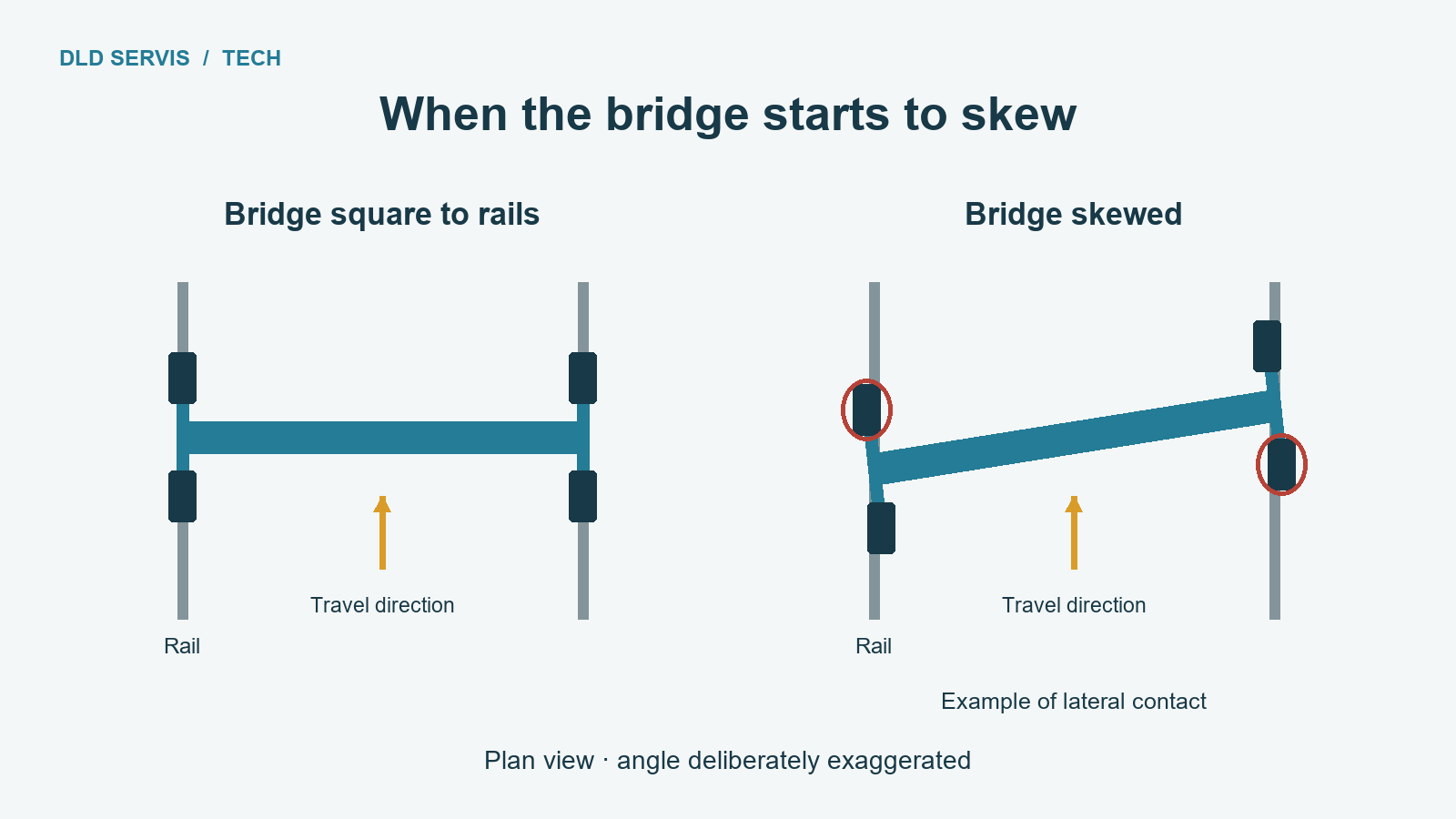
If one side of the bridge advances relative to the other, the crane turns slightly out of alignment with the runway. During this skewing, flanges may contact the sides of the rails, generating lateral forces. Their effects extend into wheel mountings, end carriages and the structure. Wear also changes the conditions for subsequent travel.
The investigation therefore covers several connected areas:
- The runway: horizontal and vertical alignment, gauge, local deviations, rail joints and fastenings.
- The running gear: wheel position and alignment, differences in effective diameters, bearings, clearances and assembly geometry.
- Drives and brakes: different behaviour on the two sides during starting, steady travel and stopping.
- Operating conditions: trolley and load position, load distribution, contamination and changes in wheel–rail adhesion.
This is not a diagnosis or a ranking of suspects. Unequal wheel loading, for example, can affect rail contact, but its significance depends on the crane arrangement.
What research in Košice demonstrated
In a 2023 paper in Sensors, researchers from the Technical University of Košice used sensors to investigate incorrect travel behaviour. Their experiment used a laboratory double-girder crane with a 2.5-metre span and a 50-kilogram capacity. Different control of the travel drives induced skewing whose effects could be detected through strain measurements.
The useful practical lesson is a principle: an apparent wheel problem can originate in the interaction of drives and structure. A laboratory result is not a universal setting for an industrial crane. Forces, permissible deviations and corrective measures depend on the particular machine.
Ask where and when it happens
A service investigation benefits from knowing whether the symptom recurs at the same runway location, during starting or braking, or with the trolley in a particular position. A location-dependent symptom directs attention differently from one that follows the bridge throughout the building. Neither observation replaces measurement.
A useful record identifies the wheel and side, documents both the wheel and the corresponding rail, and describes the operating conditions. An assessment combines that evidence with runway geometry, wheel mountings, drive condition and machine documentation. Replacing a part or aligning a rail without this context may merely postpone the problem.
A repair needs a new baseline
After repair, record the geometry and contact surfaces, verify behaviour in the applicable operational tests and monitor subsequent changes. Comparison then shows whether the adverse trend has stopped. The objective is not for every wheel to look identical in a photograph, but for the whole system to work within its intended conditions.
Overhead crane service and repairs · Crane runway service and alignment
ISO 12488-1:2012 addresses geometrical tolerances for wheels and tracks. Its official catalogue entry was checked on 26 October 2026; this article does not reproduce numerical tolerances from the full standard. Wear limits and further action require the documentation and professional assessment of the particular machine. ISO 12488-1:2012