
A component weighing several tonnes approaches an assembly fixture. From the cab, the operator can see its position in the building, but the load itself may conceal the edge that needs to be aligned precisely. Someone on the floor has a better view of that edge. Yet that person is also closer to the place where the load could swing or trap somebody. Changing a crane's controls therefore also changes the operator's workplace.
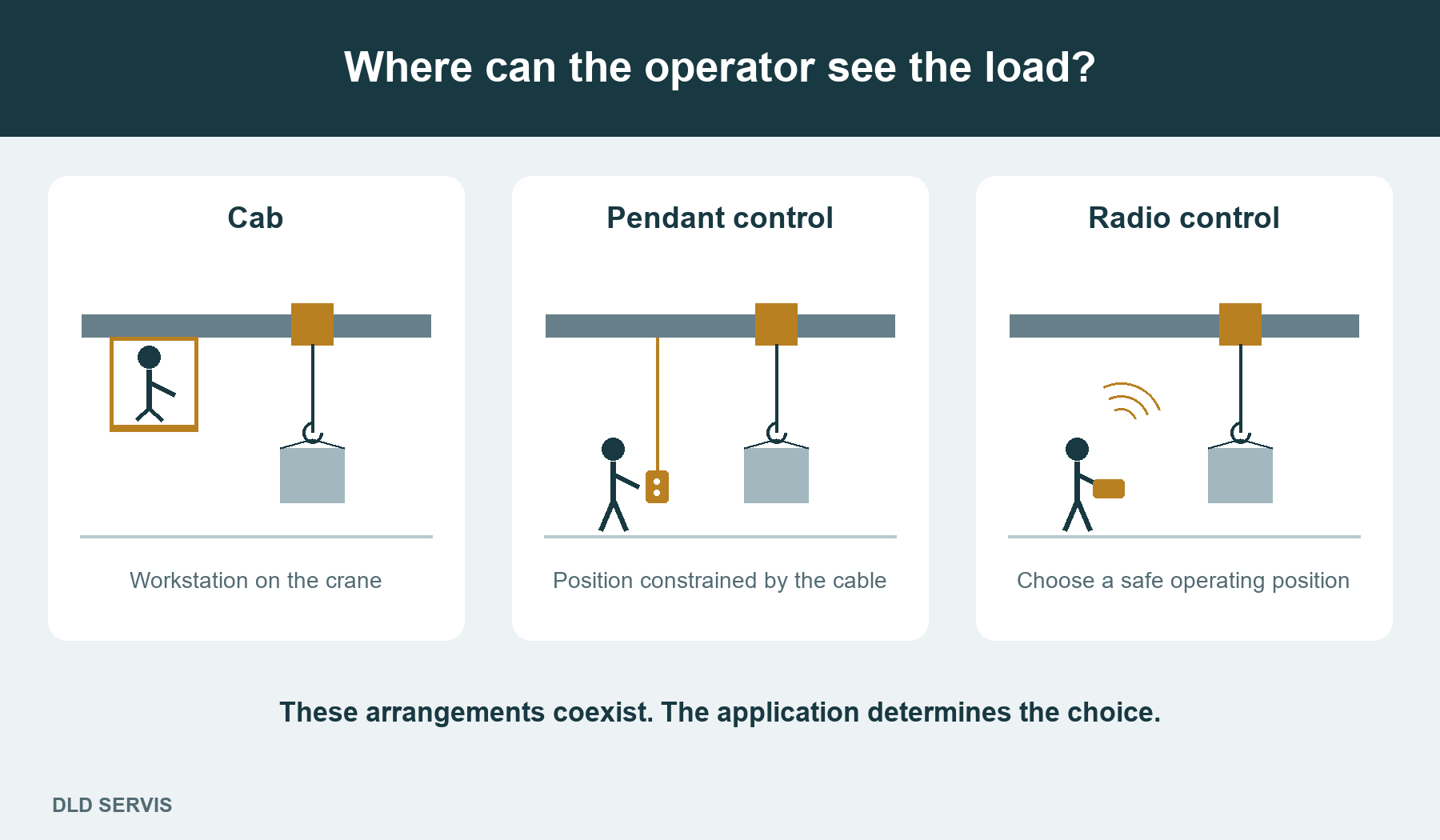
The cab, wired pendant and radio transmitter offer three different ways of connecting a human command to machine movement. Their development has brought greater freedom, but it has not removed the fundamental question: where can the operator reliably assess the load's movement and intervene without endangering themselves or anyone nearby?
When the operator worked above the floor
The former Liverpool Road goods station in Manchester offers a documented historical example. According to the Science and Industry Museum's curatorial account, the structure supporting its travelling cranes was demonstrably in place by 1884. Operators worked from an elevated platform or cab. Wooden cabs remained on the site into the late 1970s, when the museum took it over. This example demonstrates the long working life of one arrangement, rather than establishing when cab control was invented. Source: Science and Industry Museum.
An elevated station separates the operator from floor traffic and provides an overview of a larger working area. But it has its own sightlines. A girder, column, trolley or tall product can hide the very point that determines whether the load can be placed safely. Seeing across the building and seeing the final few centimetres of a handling operation are different things.
The cab still has a role
Assessing a cab means considering control accessibility, posture, visibility, access to the station and conditions during prolonged work. Suitability cannot be judged from the crane's age alone. A position above floor level may make sense where the operator needs to monitor a large area or where being close to the load would introduce additional hazards.
The US OSHA regulation 1910.179 expressly connects control reach with visibility of the hook when specifying cab arrangements. This is a useful engineering principle; US rules do not, however, replace Slovak requirements. The current ISO 7752-5:2021 also addresses the arrangement of basic controls on cab-operated overhead travelling and portal bridge cranes. The cab is therefore far from being merely a museum exhibit. OSHA 1910.179, ISO 7752-5:2021.
The pendant brought the operator to the job
With wired control, the operator holds a push-button station, commonly called a pendant. Electrical wiring carries the commands. The pendant may hang near the hoisting mechanism or run on a separate travelling suspension; the particular arrangement determines where the operator can stand.
The benefit is direct observation of the handling area from floor level. The operator may be better able to judge the component's position relative to supports or a fixture. This proximity requires a safe route, however: the person must watch both the load and their own movement between materials, workstations and traffic. Cable length must not force the operator into a hazardous area.
The cable is also a component that can be damaged or snagged. Inspection must consider its condition, strain relief, the pendant enclosure, legible direction markings and correct push-button operation. OSHA requires pendant push-buttons to return to the off position when released. A particular crane in Slovakia is inspected against its own documentation and applicable requirements, rather than a universal online procedure. OSHA provisions on controllers.
Radio removes the cable, not the rules for movement
Radio control removes the physical connection between the portable controller and receiver. Operators can choose a more suitable observation point. That freedom is useful, for example, when a large product obscures the placement area from one side. It is not permission to operate from behind an obstruction or walk alongside a moving load without an established procedure.
Transmitter range and safe visibility are different quantities. A signal may reach places from which the operator can no longer see a hazardous situation. Before changing position, the handling operation must first be interrupted safely and the instructions and working procedure followed; relocation must not introduce an unintended command. Australia's WorkSafe Victoria specifically highlights unintended operation, suitable operating positions, protected buttons and safe transmitter storage. WorkSafe Victoria guidance.
If the operator cannot observe the load's entire path directly or through suitable equipment, Slovak Government Regulation No. 392/2006 requires communication with an appointed person who directs the operator. A wireless controller does not remove that need. Slov-Lex, Annex 2, point 4.2.3.
What must happen when the command disappears
Testing radio control involves more than checking whether the crane moves when a button is pressed. Behaviour on loss of communication, switching on, restoration of power or release of the control is equally important. Loss of signal must produce a defined safe response, not continuation of the last movement. WorkSafe Victoria emphasises a safe state on signal loss and prevention of starting with a movement control already displaced from neutral.
The entire chain therefore needs assessment: transmitter, receiver, interface with the control system, drives and brakes. Emergency stopping does not replace correct operational stopping or safe energy isolation for maintenance. Nor does simply replacing a push-button pendant with radio control change the motors' starting characteristics. Fine positioning also depends on the drive, regulation, braking and behaviour of the suspended load; the command transmission method alone does not determine it.
Modernisation starts with observing the work
Before selecting new controls, it is worth following the actual handling cycle: where the load is collected, what obstructs the view, where people move and from where placement will be controlled. Operating positions can then be compared and the necessary functions identified. With several cranes, the controller must be clearly associated with the correct machine; with several control stations, transfer of control must be unambiguous.
Preparation also covers electrical diagrams, stopping arrangements, interlocks, direction markings, testing after modification and operator training. The Slovak regulation addresses control system safety, intentional starting, inspections following relevant modifications and documented training. Slovak Government Regulation No. 392/2006.
STN EN 13557, issued in 2024, is the current Slovak standard for the design of crane control devices and control stations. Cableless control is addressed by STN EN 62745, issued in 2017, with amendment A11 listed in its catalogue record. These cover different areas of assessment. The catalogue records confirm editions and scope; they do not replace the complete standards. Moreover, EN 13557:2024 expressly excludes cranes manufactured before its publication, so it cannot simply be prescribed for every older machine without considering applicability. ÚNMS: STN EN 13557, ÚNMS: STN EN 62745.
During overhead crane servicing, controls should therefore be considered alongside the machine's technical condition and the handling environment. A well-chosen operating position helps a person recognise trouble early. A correctly designed control system must then carry out the command reliably — including the command to stop.
For the wider engineering background, see our article on the history of overhead cranes.