
In an old engine house, the machinery below usually catches the eye first. The steel bridge overhead comes second. Yet that bridge made it possible to assemble the equipment, open it for repairs and put it back to work. The history of overhead cranes follows a question that still matters in manufacturing: how do we put a heavy component exactly where it is needed?
No single invention or famous year provides the whole answer. Energy sources, power transmission and controls changed. The basic motions remain familiar: lifting the load, moving the trolley across the bridge and travelling along the runway.
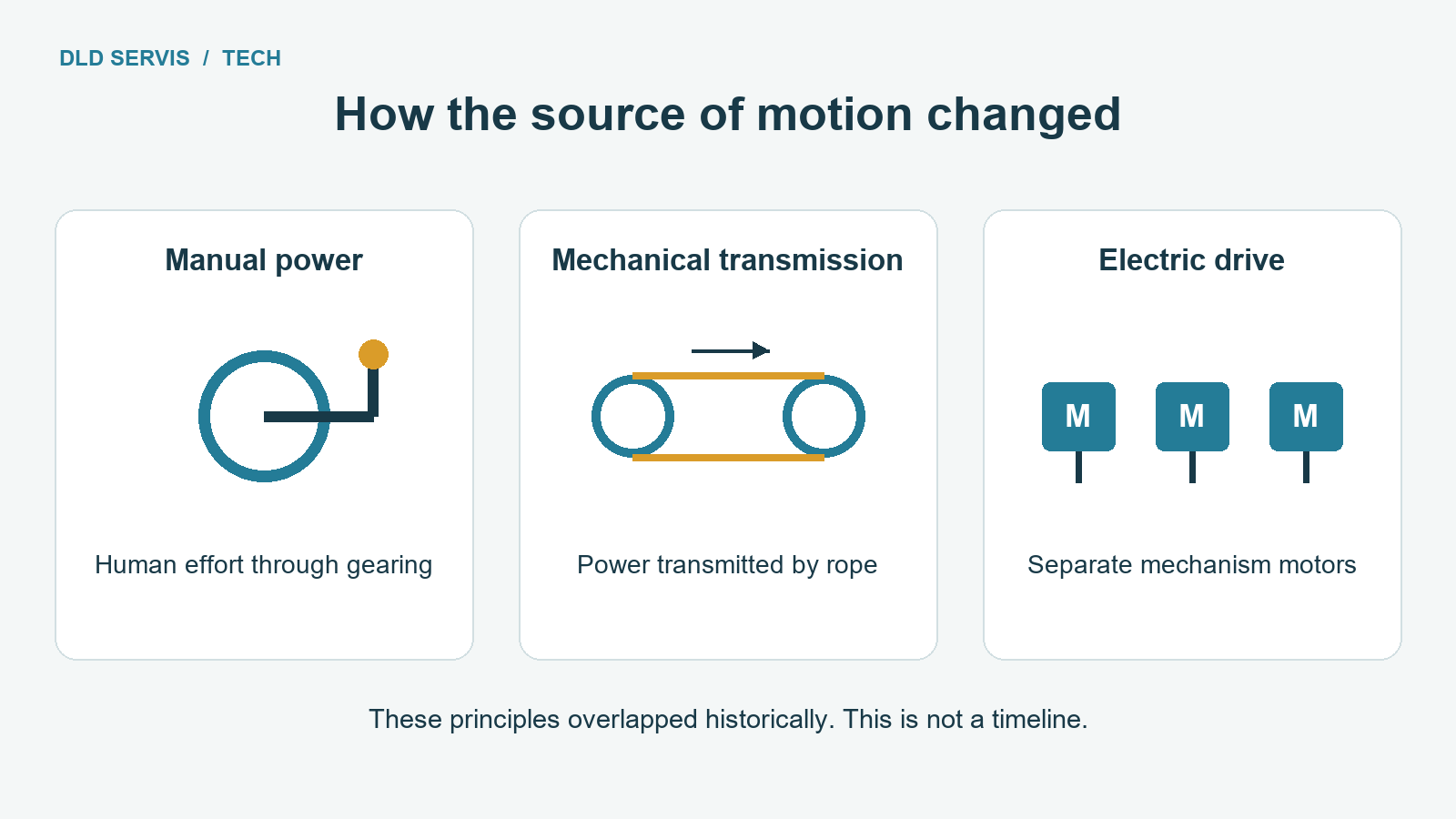
Manual did not mean small
At Australia's Spotswood pumping station, a double-girder overhead crane dating from around 1894 spanned 16.76 metres. The Museums Victoria record identifies it as originally entirely manual. A large span alone therefore does not tell us whether a crane needed electricity.
Gearing and pulleys trade a longer input movement for greater lifting force. The operator need not exert a force equal to the weight of the load, but still has to supply the necessary work. A slow lift for occasional machinery dismantling has a different value from repeated material handling on a production line.
Spotswood also illustrates a less familiar route to modernisation: a compressed-air-powered winch was later fitted for lifting while travel remained manual. Progress did not always mean replacing the whole crane.
When power arrived by rope
Between manual effort and motors mounted at individual mechanisms, there were arrangements that brought power to the crane mechanically. Science Museum Group preserves a rope-driven overhead crane made in 1904. Here the rope's function matters: it can transmit power rather than simply support a hook.
That changes how we read an old machine. Following a rope means asking not only what it lifts, but where its motion originates. The source of power and the lifting mechanism did not necessarily sit next to each other.
Steam above the goods yard
By 1884, Manchester's Liverpool Road station had a structure supporting steam-powered travelling cranes. A Science and Industry Museum curator describes probable rope transmission from a remote engine and places conversion to electricity around the 1920s. “Probable” and “around” matter: the source does not supply an exact date for every alteration.
The goods yard reminds us that lifting belonged to a larger flow of materials. A crane's usefulness was not just its lifting capacity; it also helped empty wagons and free space for the next delivery.
Electricity shared the work between motors
Science Museum Group also holds a model of a three-motor electric overhead crane. Its object number 1908-35 is not treated here as proof of a manufacturing date. The documented feature is the three-motor arrangement.
Separate drives allow lifting and the two travel motions to be addressed independently. Electrification therefore involves more than exchanging human effort for a motor. Power supply, switching, coordination and braking become part of the engineering problem. An electrically driven hoist may still operate on an older structure.
What this history leaves in today's workshop
An older crane can contain components from several periods: an original bridge, a replacement hoist and newer controls. A year on a nameplate cannot explain all its characteristics. Assessment needs to connect the documentation with the actual construction and the record of alterations.
The most revealing feature of this history is not a tidy succession of manual, steam and electric ages, but their overlap. New power was often adapted to what already stood in the workshop. A good modernisation still begins with understanding the complete machine, rather than choosing one new component.
DLD Servis: overhead crane service and repairs
Historical examples come from the linked museum records, checked26October2026. This is neither a complete chronology nor a claim about a world first. Technical explanations are editorial commentary; this article is not a conversion procedure.