
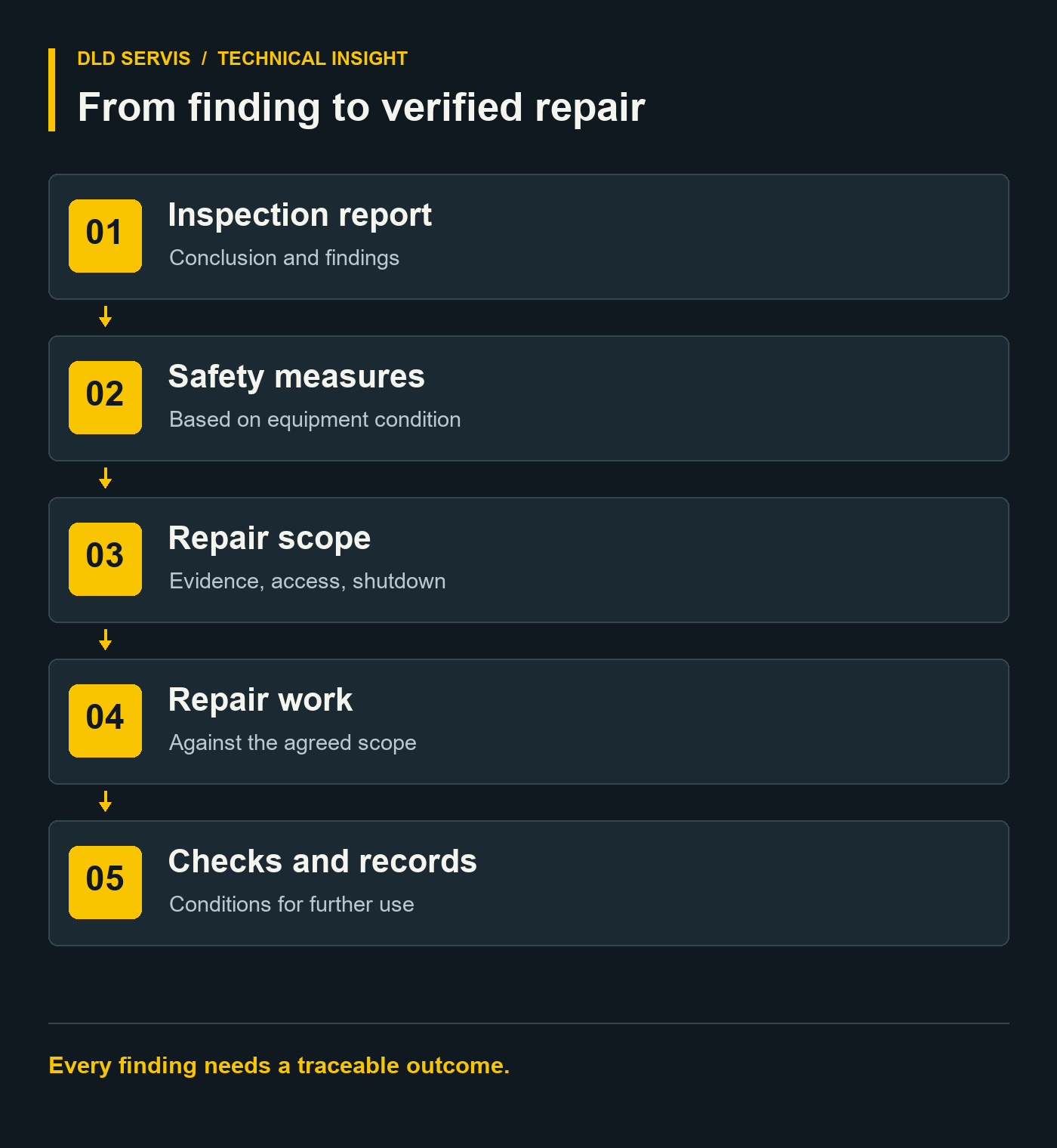
An inspection report lists defects, while production needs answers to two questions: can the crane keep working, and what needs to be ordered? Copying the defect list into a request for quotation is only part of the job. First establish what the report concludes, then define the repair scope and how the result will be verified.
A workable plan links each finding to an identified asset, a responsible person, an action and evidence of completion. This article addresses planning within the Slovak regulatory framework. The English translation does not turn Slovak requirements into rules for other countries.
Read the conclusion before booking the repair
Start with the overall assessment of whether the equipment is fit for further operation. Section 16(2) of Slovak Decree No. 508/2009 Z. z. distinguishes defects, their significance, the overall assessment and proposed measures. A description of a damaged component is not, by itself, the complete operational decision.
If the conclusion identifies immediate danger or unfitness for safe operation, production pressure cannot resolve the defect. Take the equipment out of service and secure it against use under the site's arrangements. Clarify an ambiguous conclusion with the inspection technician. Do not invent operating restrictions, such as assuming that lighter loads make continued use acceptable.
Give every finding a location and supporting information
A workshop may contain several similar cranes. “Loose fastening” without a location is insufficient for preparing materials. Keep the original report numbering and build a work list containing:
- the crane or runway identification and exact location,
- the original finding and report page reference,
- an overall photograph and a close-up, where these can be taken safely,
- the measures and restrictions stated in the report,
- the responsible person, agreed date and verification method.
Photographs help identify the correct asset and component. They do not replace measurement or competent assessment. Never enter a hazardous area or an unsecured structure just to obtain a photograph.
Separate the observed condition from the repair scope
Illustrative example: a report notes damage around a rail fastening. Before ordering clips, establish which locations require attention, which components are actually installed, and whether the supporting surface or alignment also needs assessment. This is a planning example, not a DLD case history or a diagnosis from a photograph.
The site visit should distinguish what is established from what still needs investigation. Dimensions, materials and fixing arrangements must not be guessed. If the work involves the load-bearing structure, a safety function or changes to documentation, the assessment and specification must reflect that scope.
Specify the result, not just the replacement parts
Provide the full inspection report, available equipment documentation, asset identification, photographs and access conditions. Include working height, outage opportunities, operation of adjacent cranes and a maintenance contact.
Ask the quotation to distinguish the survey and measurements, materials, dismantling and installation, access equipment, any surface treatment, post-repair verification and handover documents. Where a price depends on opening up a component or taking measurements, record that condition explicitly. It is better to resolve the uncertainty before work starts than during handover.
Plan the outage with the operating team
The programme needs time for both site preparation and final verification. Agree who hands over the equipment, how unintended movement or energisation will be prevented, and how the area below the work will be separated. Account for nearby machinery. The actual energy-isolation procedure must be prepared by qualified people for the equipment concerned.
Also decide who can approve a revised scope if further damage is found during dismantling, how the change will be recorded and what it means for the outage. A programme allowance supports proper verification; it is not a reason to shorten necessary checks.
Completed installation does not close the whole job
Section 9 of Slovak Decree No. 508/2009 Z. z. addresses safety-condition checks, including checks before return to service after repair or reconstruction. The type, scope and person carrying out the verification depend on the equipment and intervention. Neither a universal test for every repair nor an invoice for new parts is an adequate substitute for determining the applicable requirements.
Agree in advance what evidence will close each report item. Depending on the work, this may include a work record, identification of replacement components, measurements and the results of relevant inspections or tests. The operator needs a clear statement of what has been addressed and any remaining conditions for use.
Three questions at handover
- Can every finding be traced? Connect the original observation to the work and its verification.
- Do the records describe the actual equipment? Asset identification, work location and components must be clear.
- Has return to service been addressed? The installation completion date alone does not answer that question.
Send DLD Servis the inspection report and basic equipment information to prepare a site visit and clarify the repair scope. For alignment-related questions, see When a crane runway needs a professional survey.
Source and scope
Slov-Lex: Slovak Decree No. 508/2009 Z. z., particularly Sections 8, 9 and 16, version effective from 1 September 2014; checked on 14 October 2026. The planning checklist and illustrative example are editorial guidance. Local requirements apply to equipment outside Slovakia. This article is not an equipment assessment or a repair procedure.